

PRAY THE
STATIONS OF THE CROSS
The fourteen Stations of the Cross, painted by Utah artist Roger “Sam” Wilson in 1992 and 1993, replaced the original set which had deteriorated badly. They generally follow a revised (and more biblical) version of the stations produced by the Vatican in 1975. The stations combine elements of traditional iconography and American Southwestern coloration within a postmodern style. In developing each scene, the artist used flowers, animals and various symbolic elements to draw out its meaning and significance. The Stations were placed in the frames carved and installed in 1918 by William F. Ross and Company of East Cambridge, Massachusetts.
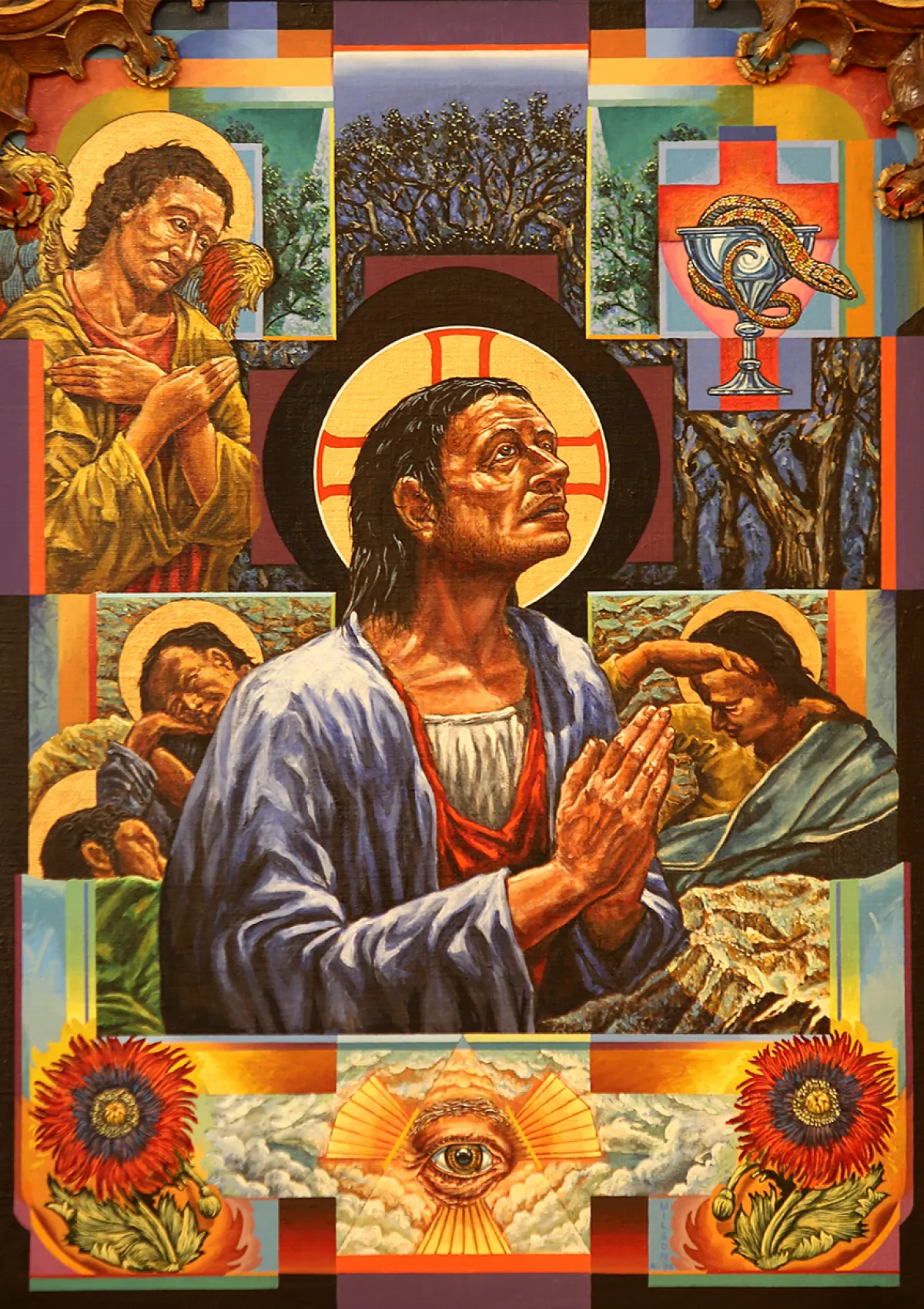
I. JESUS IN THE GARDEN OF OLIVES.
The impending death of Jesus is signified by the chalice with the snake wreathed around it evoking, the deathly serpent of the Garden of Eden and the notion of the Garden of Olives as the outcome of Eden. The poppies suggest the sleep of the three disciples and more generally the evasion of reality as a human temptation. While the suffering Jesus contemplates only his impending death, the eye of God symbolizes the providential vision of the Father in whose power life triumphs over fear and death. In this station, as in all the others, the artist’s use of the shape of the cross to organize the various elements of the painting is apparent.
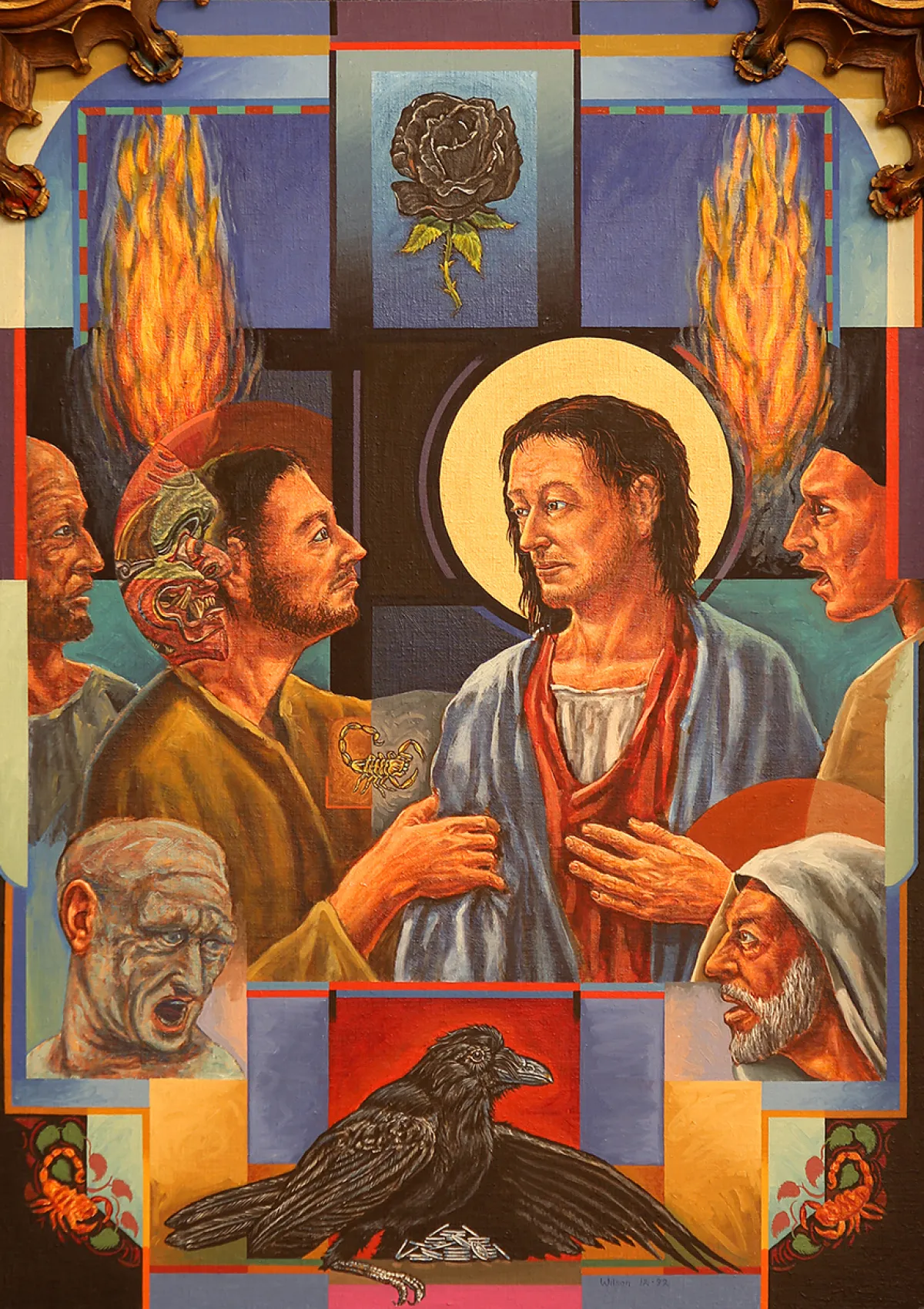
II. JESUS IS BETRAYED BY JUDAS.
The temptation of Judas is portrayed by the mask of evil within Judas’ halo. The use of masks throughout the stations suggests the influence of dark and sinister forces. The black rose is a frequently used symbol of deceit and betrayal. The danger lurking in Jesus’ embrace of Judas is suggested by the scorpions which appear on Judas’ sleeve and again at the bottom of the picture. The raven, here guarding the thirty pieces of silver, is a familiar image of decadence and the underworld. The high priest’s servant whose ear was cut off but healed by Jesus appears with a blue face to highlight the flesh- colored ear.
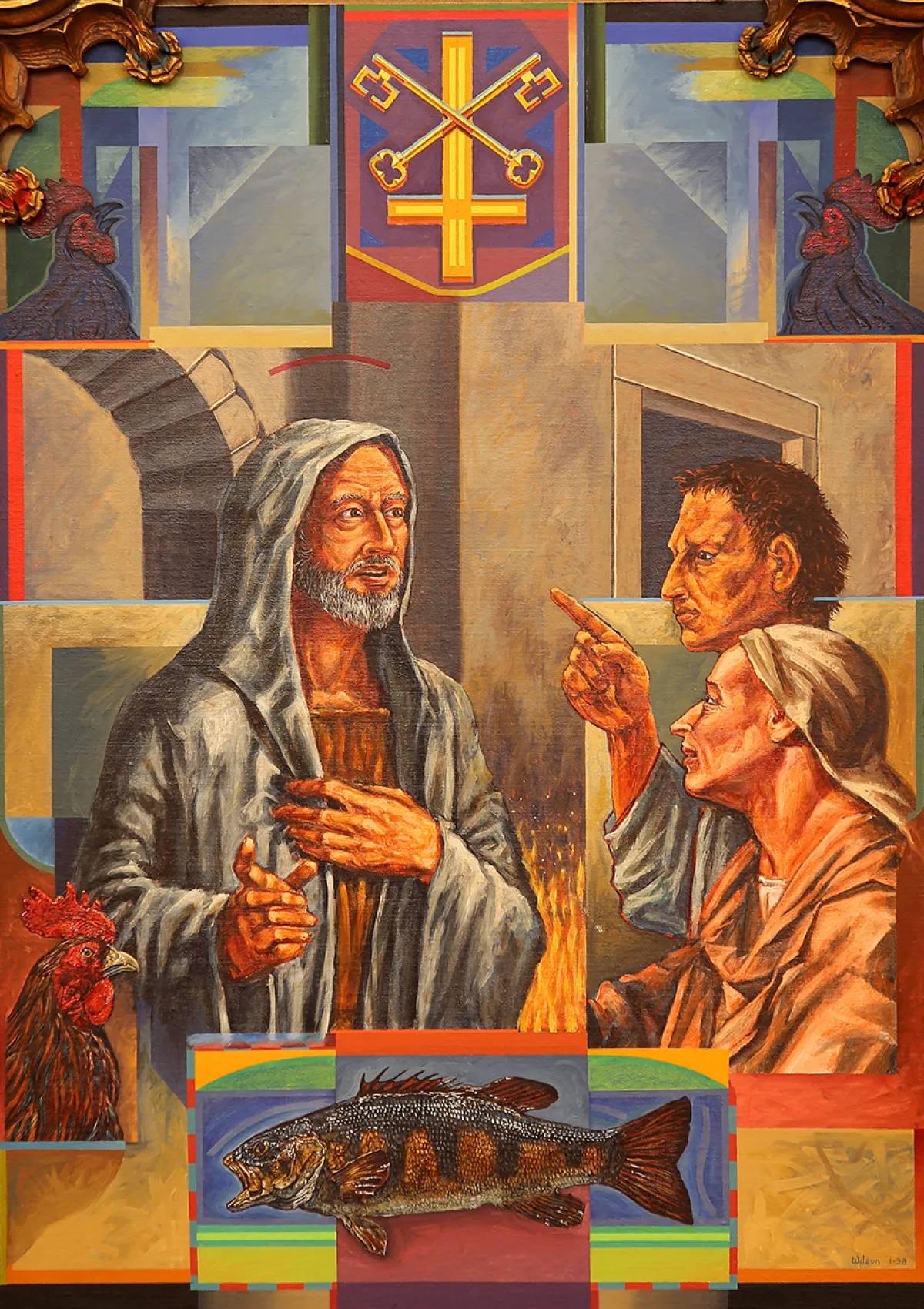
III. JESUS IS DENIED BY PETER.
The denial of Jesus by Peter is dramatically underlined by the crowing cocks. The keys, symbolic of Peter’s apostolic office, are superimposed on the upside down cross on which, according to tradition, Peter was crucified. The fish symbolizes Peter’s actual occupation before he followed Jesus and the apostolic role of Peter as the fisher of men. The fish is also an early symbol of the Christian community. The partial halo over Peter’s head suggests the crisis in fidelity and integrity which the scene signifies.
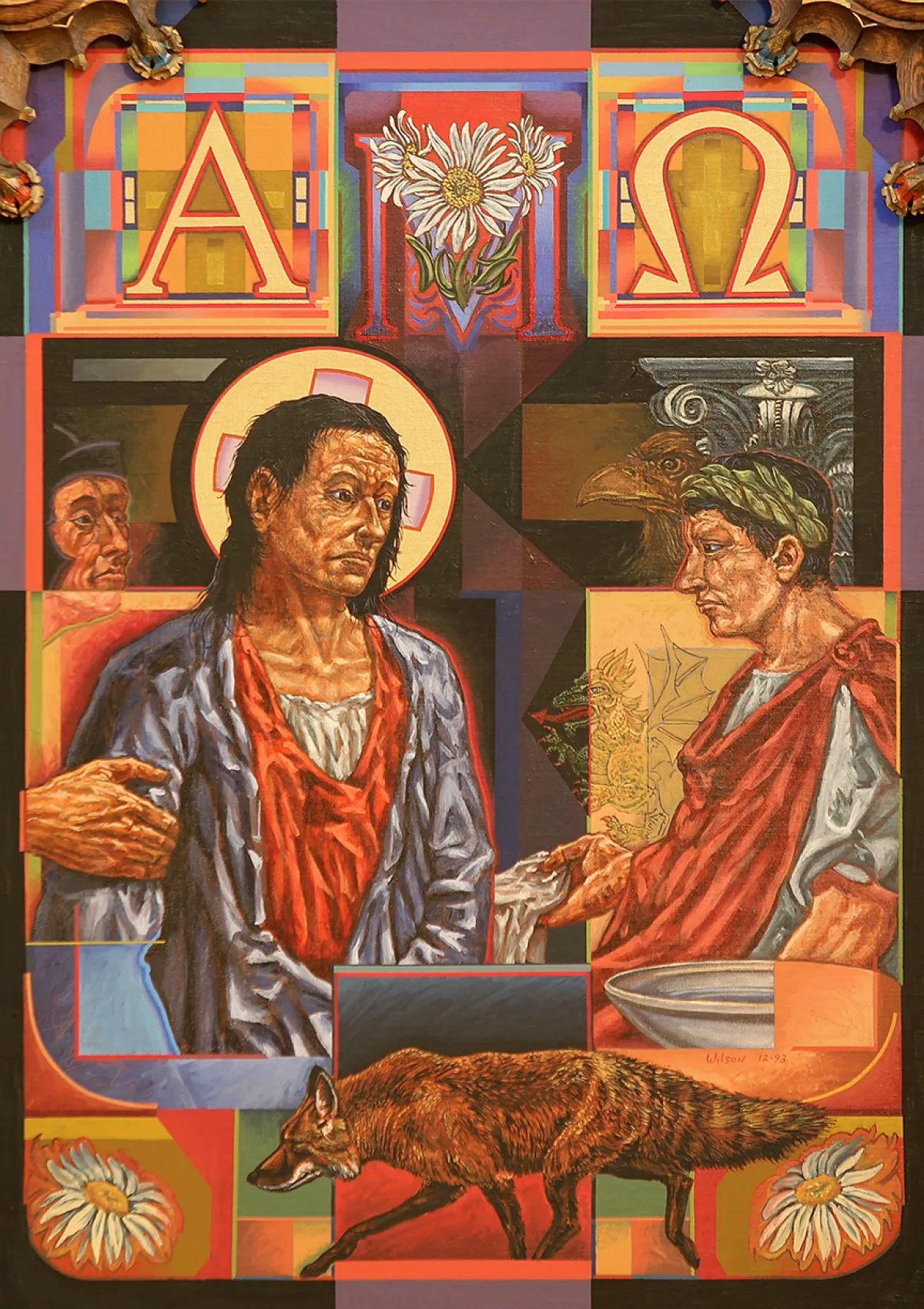
IV. PILATE CONDEMNS JESUS TO DEATH.
The Roman imperial power of Pilate is symbolized by the eagle above his head, as well as by the Corinthian column. The destructive character of Pilate’s judgment is suggested by the dragon in the background. The divine power of Christ is declared by the Alpha-Omega symbolism. Christ is the beginning and the end of all things: the one whose power is greater than any human system. The fox evokes both the slyness of Pilate and Jesus’ reference to Herod as a fox. The daisies suggest the innocence of Jesus.
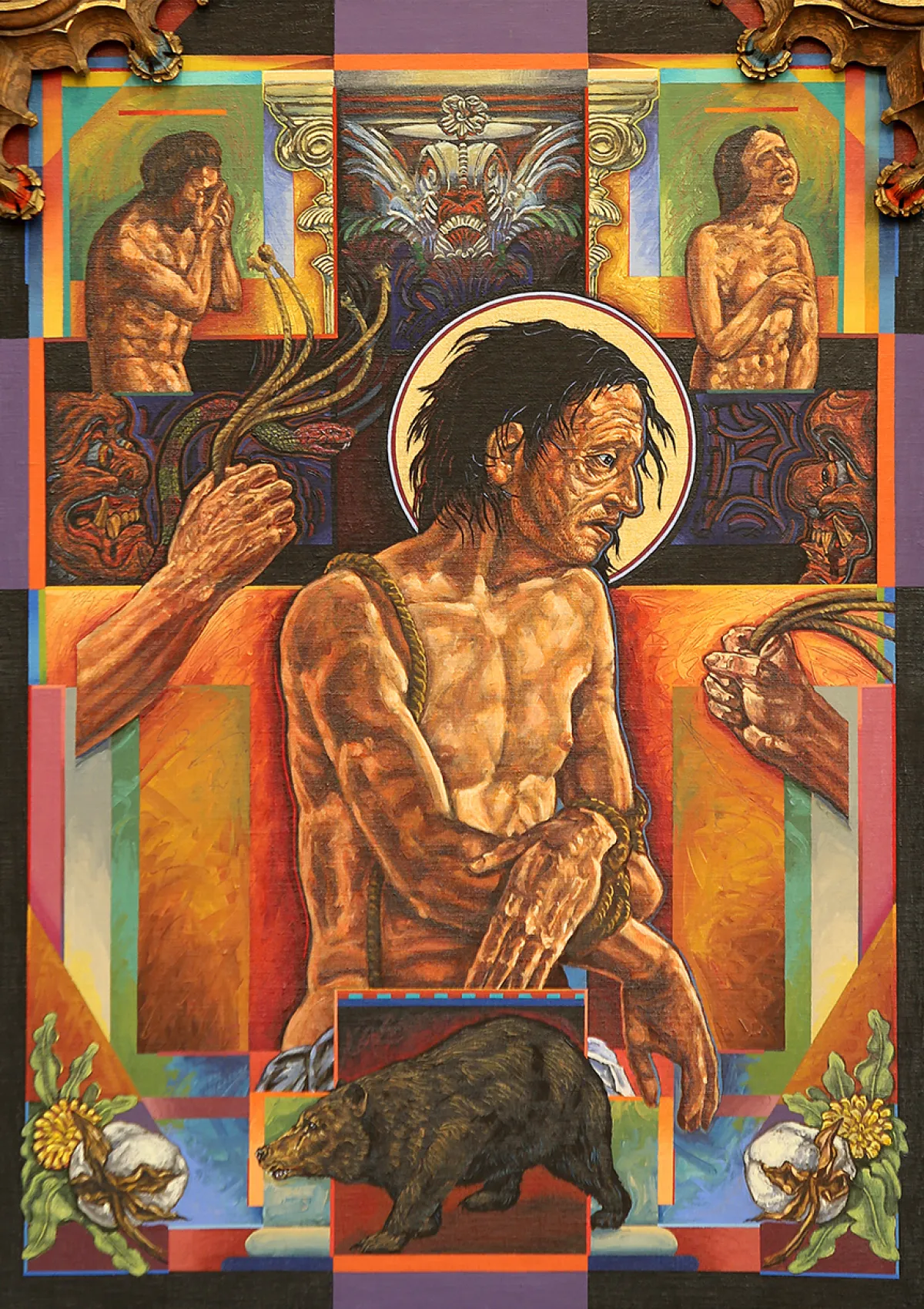
V. JESUS IS STRIPPED AND SCOURGED.
he bear, signifying the mindless violence and brutality of the scene, is also a modern symbol of totalitarian power. The naked figures (inspired by Masaccio, early 15th century) suggest, on the one hand, Adam and Eve, whose clothing after the Fall signified guilt, and on the other hand, the whole human race. The implication here is of Jesus being stripped of the human sins he took upon himself. The dandelion, which is being stripped of its “clothing” becomes the seed of new life, highlights the saving significance of this event. The cotton flowers underscore the symbolism of clothing and nakedness.
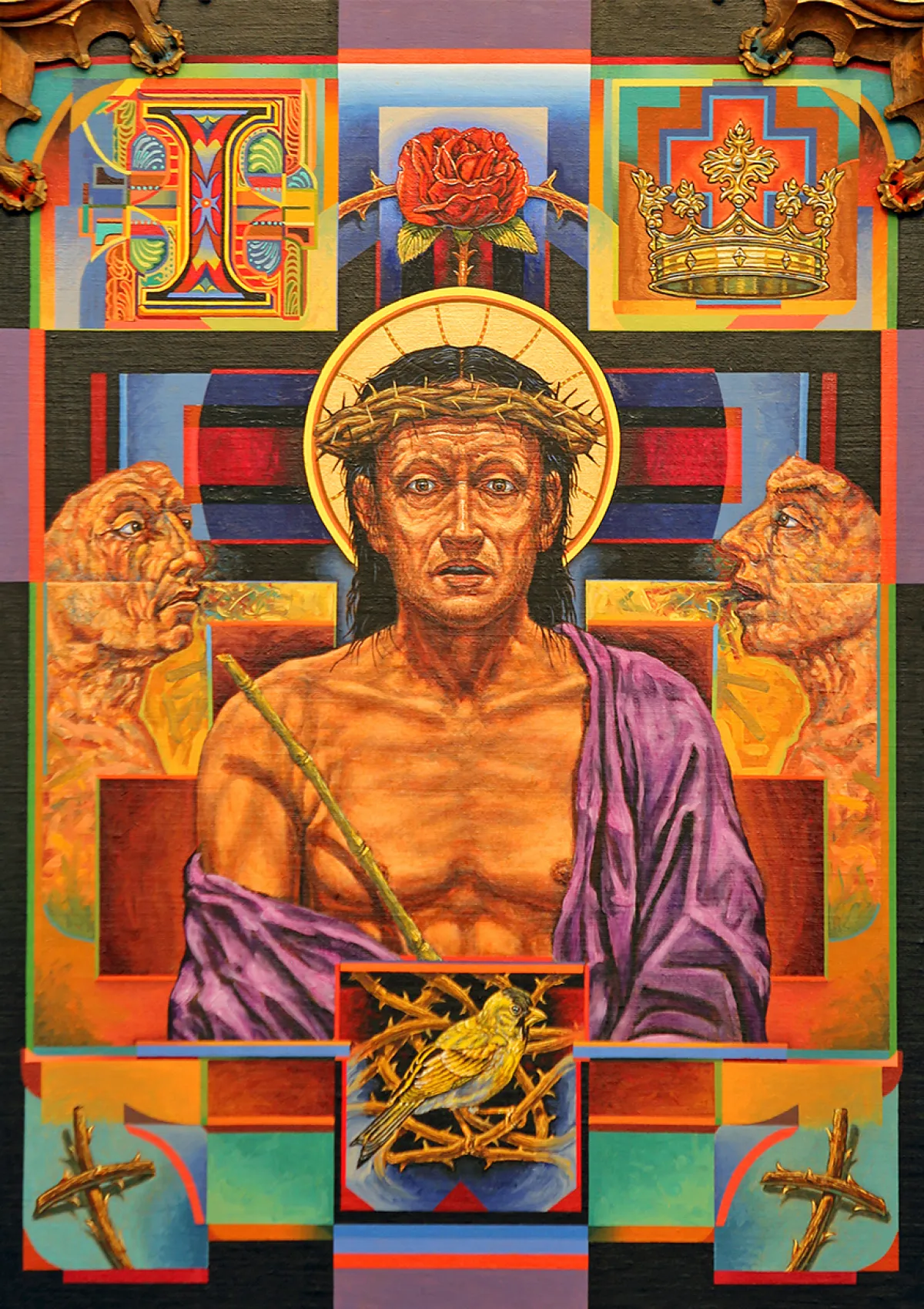
VI. JESUS IS MOCKED AND CROWNED WITH THORNS.
Jesus’ halo of thorns, crowned by a rose, suggests suffering leading to the joy or resurrection. The goldfinch, who lives in thorns, evokes the human condition as a partial dwelling in thorns. The irony of Jesus’ crowning with thorns is symbolized by the royal crown of divine son-ship. The highly decorated “I” (the first letter of the Bible “In the beginning...” signifies the original creative Word of God (decorated here in the manner of an illuminated manuscript) by comparison to which the painted words of mockery emanating from the mouths of the bystanders are a distortion and corruption.
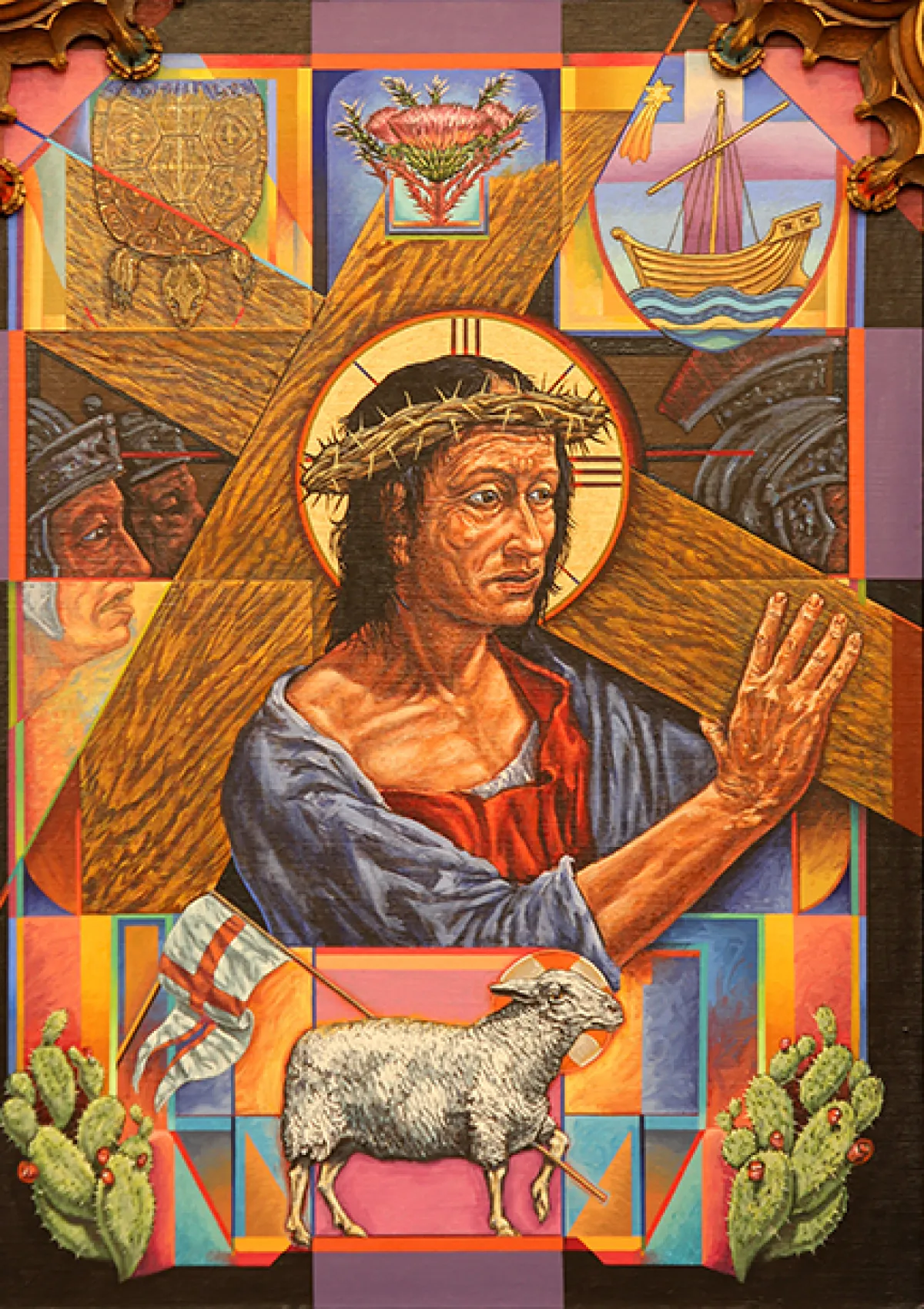
VII. JESUS CARRIES HIS CROSS.
The ordeal and struggle of carrying the cross is underlined by the presence of the thistle and the cacti, plants suggesting barrenness and discomfort, and by the turtle, an animal with tiny crosses on its shell and a slow and labored movement (a reference taken from D. H. Lawrence). The lamb carrying the sign of victory prefigures Christ’s resurrection at the end of the journey. The early Christian Fathers saw the ship and its mast as a symbol of the Church carrying the cross in every generation toward the port of heaven. These appear here in the form of the official Coat of Arms of the Diocese of Salt Lake City, thus providing a local statement of the scene’s significance.
VIII. SIMON HELPS JESUS CARRY THE CROSS.
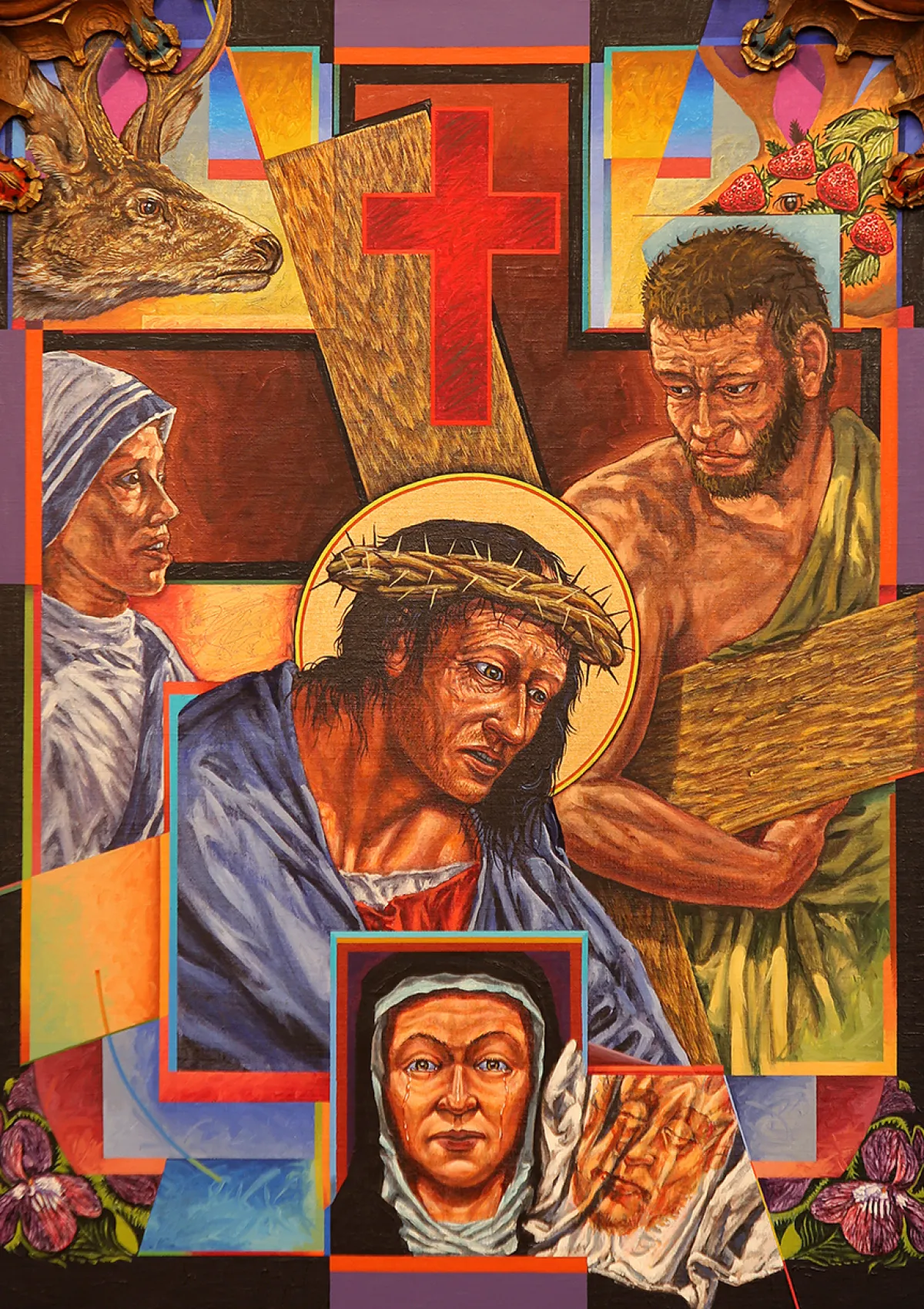
This scene incorporates the legendary and non- biblical story of Veronica wiping the face of Jesus and the miraculous imprint of his face on a cloth. The clearly identifiable red cross, a mercy symbol, and the woman dressed in the clothing of Blessed Mother of Teresa of Calcutta’s Missionaries of Charity suggest the ongoing ministry of charity in every generation. The deer, a symbol of kindness and gentleness (and whose antlers are evocative of a cross), appears at the top. The violets and the strawberries are symbols of good works and humble service.
IX. JESUS MEETS THE WOMEN OF JERUSALEM.
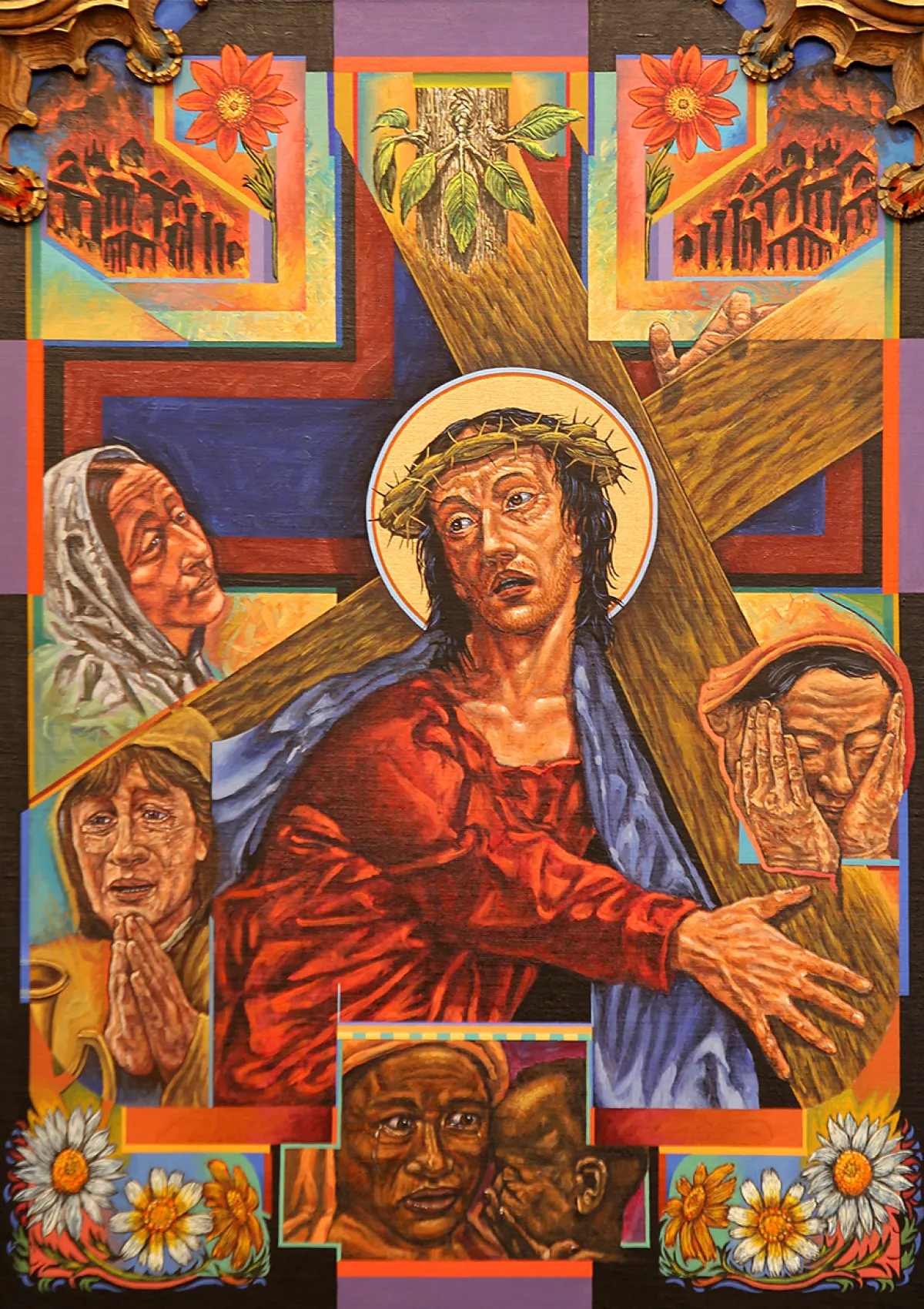
The women who met Jesus belonged to mercy groups who accompanied criminals to crucifixion and offered them potions to dull pain, hence the wine jar at the bottom left. The women also symbolize the suffering women of the world, thus their ethnic variety. The innocence of these women (by comparison with the motivations of many other figures in the stations) is signified by daisies. The anemone has traditionally been associated with sorrow and mourning. Jesus’ prediction of the destruction of Jerusalem is depicted by the city in flames. Jesus’ reference to himself using the imagery of the “greenwood” is portrayed graphically by the green leaves at the top of the cross.
X. JESUS IS NAILED TO THE CROSS.
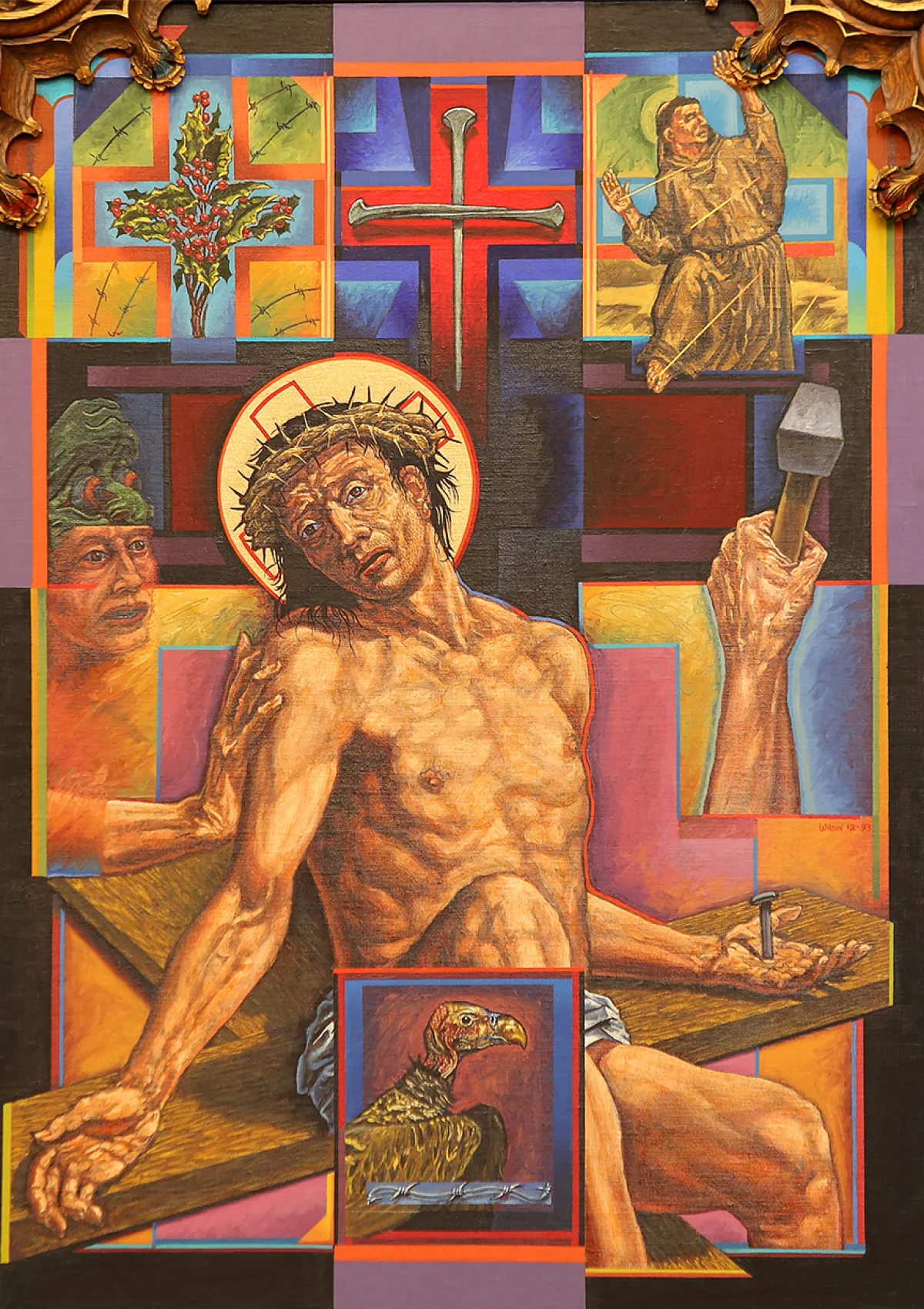
The posture of the vulture, a symbol of imminent death, highlights this scene as a vulture-like picking away at Jesus’ body. The replication of Jesus’ five wounds in the Franciscan figure (inspired by Giotto, early 14th century) reminds the Christian of Saint Paul’s admonition that “we carry about in our bodies the dying of Christ.” The nail-like barbed wire, suggesting the concentration camp, gives the scene a modern reference. The cross of nails, inspired by the original in Coventry Cathedral, England, which rose from the ashes of the medieval church destroyed in World War II, portrays triumph over war. The holly highlights the painful aspects of the world in nature.
XI. JESUS FORGIVES THE REPENTANT THIEF.
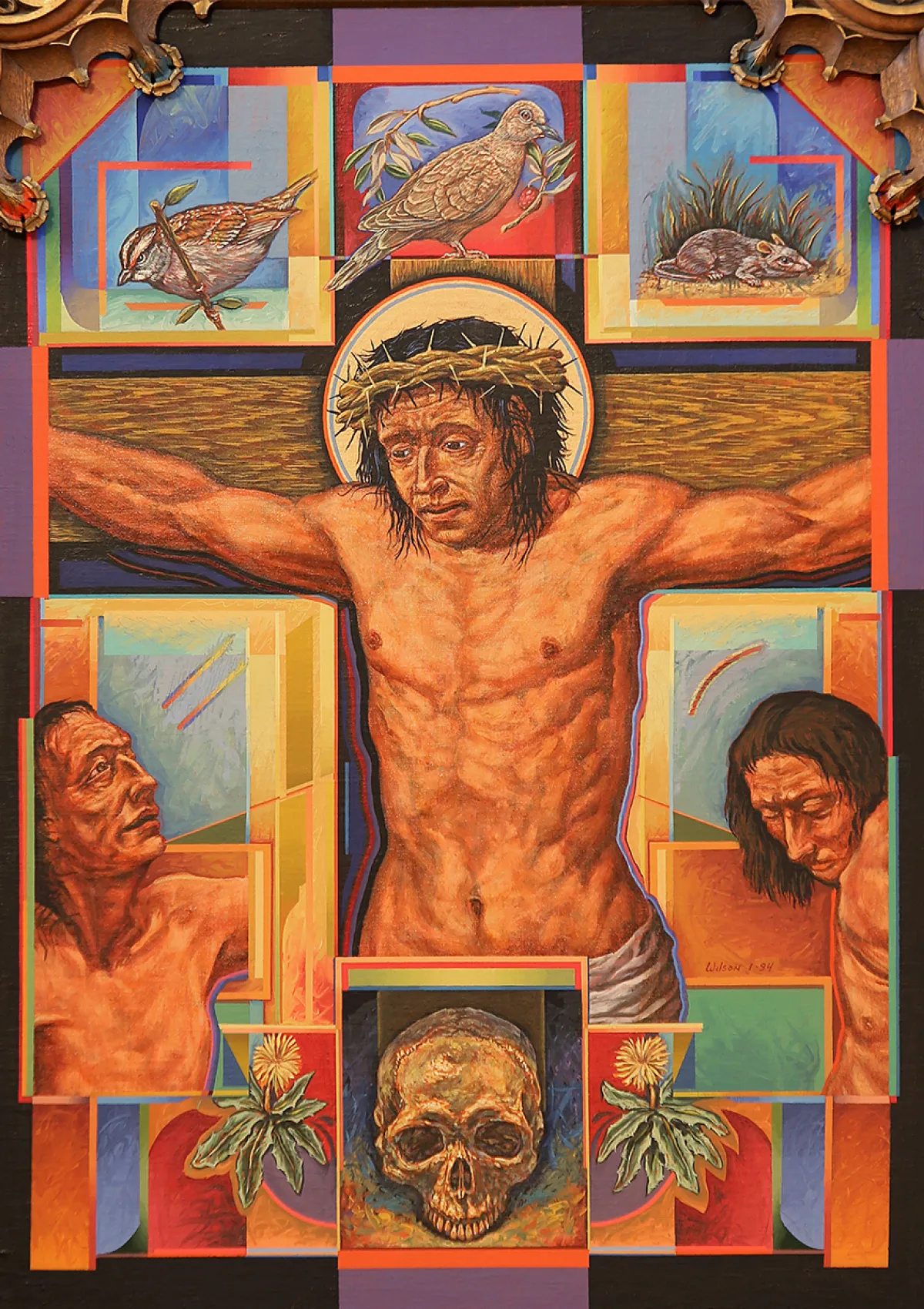
The universal significance of Jesus’ forgiveness of the repentant thief is suggested by the portrayal of Adam’s skull, which invokes the legend that Adam was buried on the hill of Calvary. The dove with the olive branch highlights this event as one of peace and reconciliation. It also calls to mind the appearance of the dove with the olive branch after the Flood and it relates this scene to the Sacrament of Reconciliation. That Jesus’ forgiveness extended to the most lowly and despised is suggested by the sparrow (an image of lowliness in Jesus’ own preaching) and by the rat and the weedy dandelions.
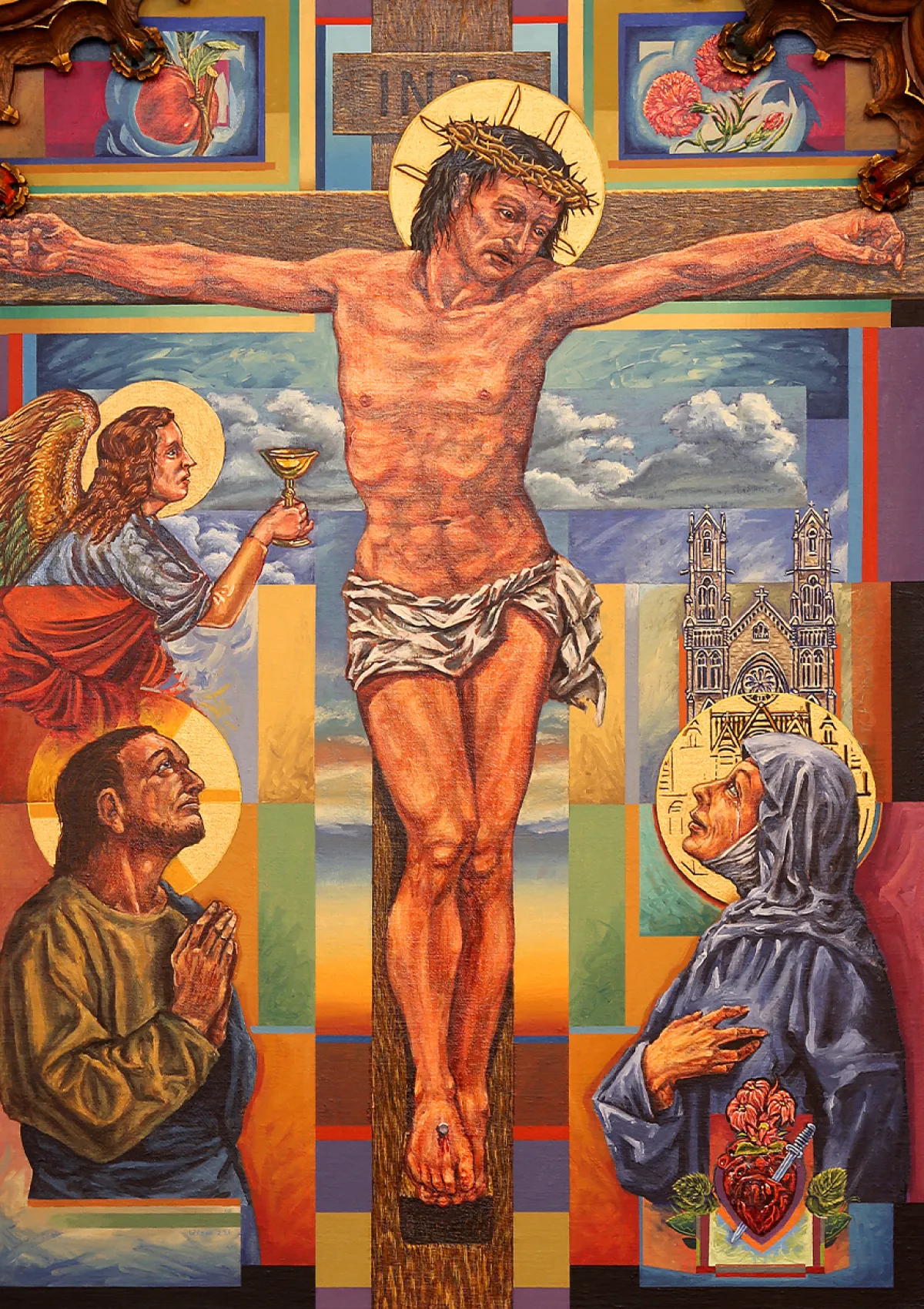
XII. JESUS SPEAKS TO HIS MOTHER AND JOHN.
The sorrow of Mary foretold by Simeon as a sword wounding a heart is represented here with a cyclamen flower, a symbol of grief. Mary’s role as Mother of the Church is suggested by the appearance of The Cathedral of the Madeleine as part of Mary’s halo. The apple signifies variously Mary as the new Eve, the cross as the fruit of Adam’s sin, and the cross as the tree of life reminiscent of the tree of Eden. The early Christian Fathers spoke of this scene as the marriage of Christ and his Church, hence the carnation, the weeping flower. The angel with the chalice dramatizes the source of the Church’s sacraments in the blood of Christ.
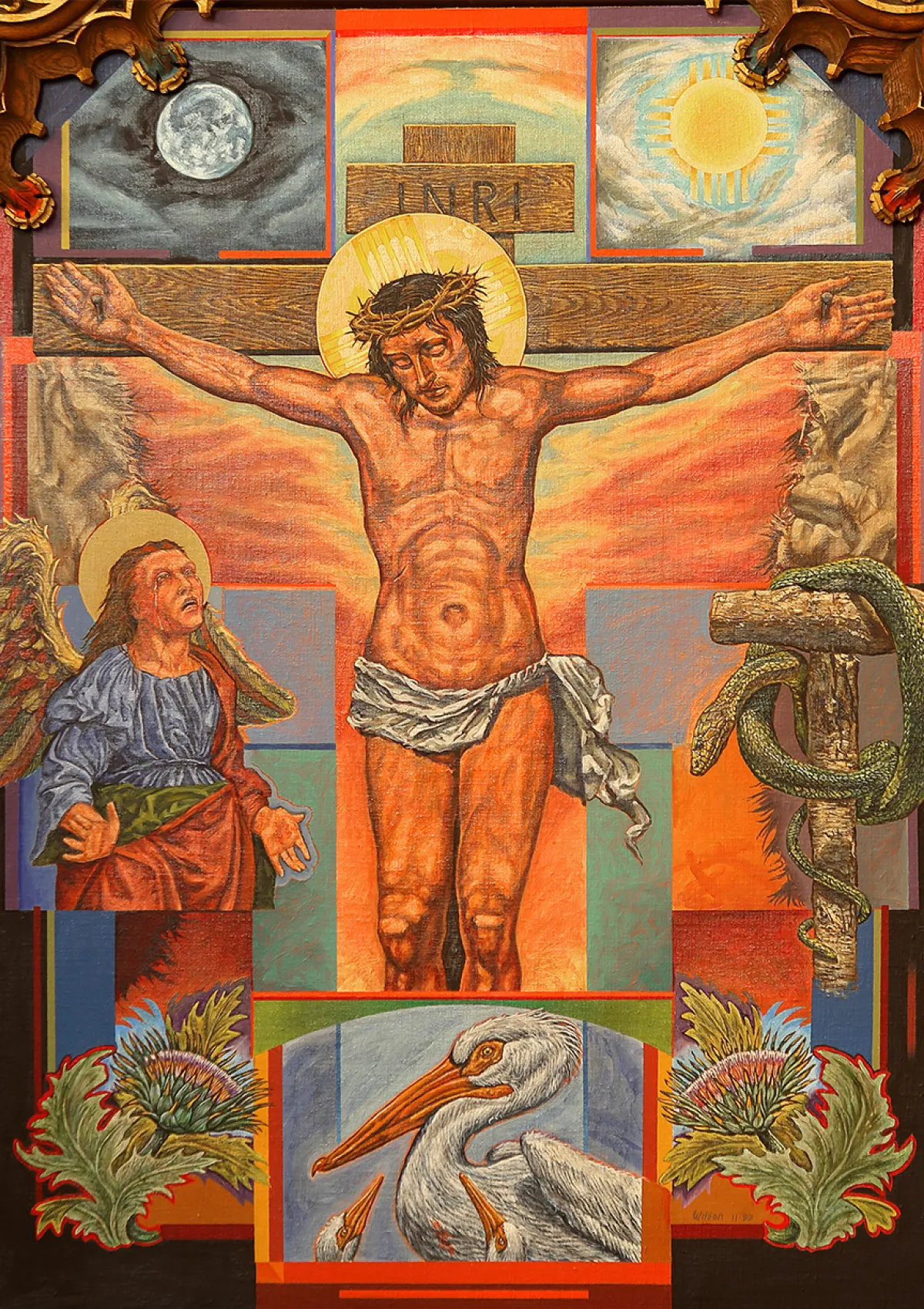
XIII. JESUS DIES ON THE CROSS.
The dead serpent on the pole, which refers back to the Book of Exodus, is in the Gospel of John a symbol of Jesus’ saving death on the cross. This imagery calls to mind Saint Paul’s declaration of the saving death of Christ as a folly and bewilderment by human standards. The pelican who feeds her children by drawing blood from her breast is a symbol of Christ’s saving death. The cosmic dimensions of Jesus’ death are represented in the dramatic red sky and the darkening sun and moon. Both the sun and Jesus’ halo incorporate the symbolism of the pre- Columbian sun. The parting of the Temple veil is graphically portrayed. The thistles, symbolic of the painful journey, now appear again as the journey ends.
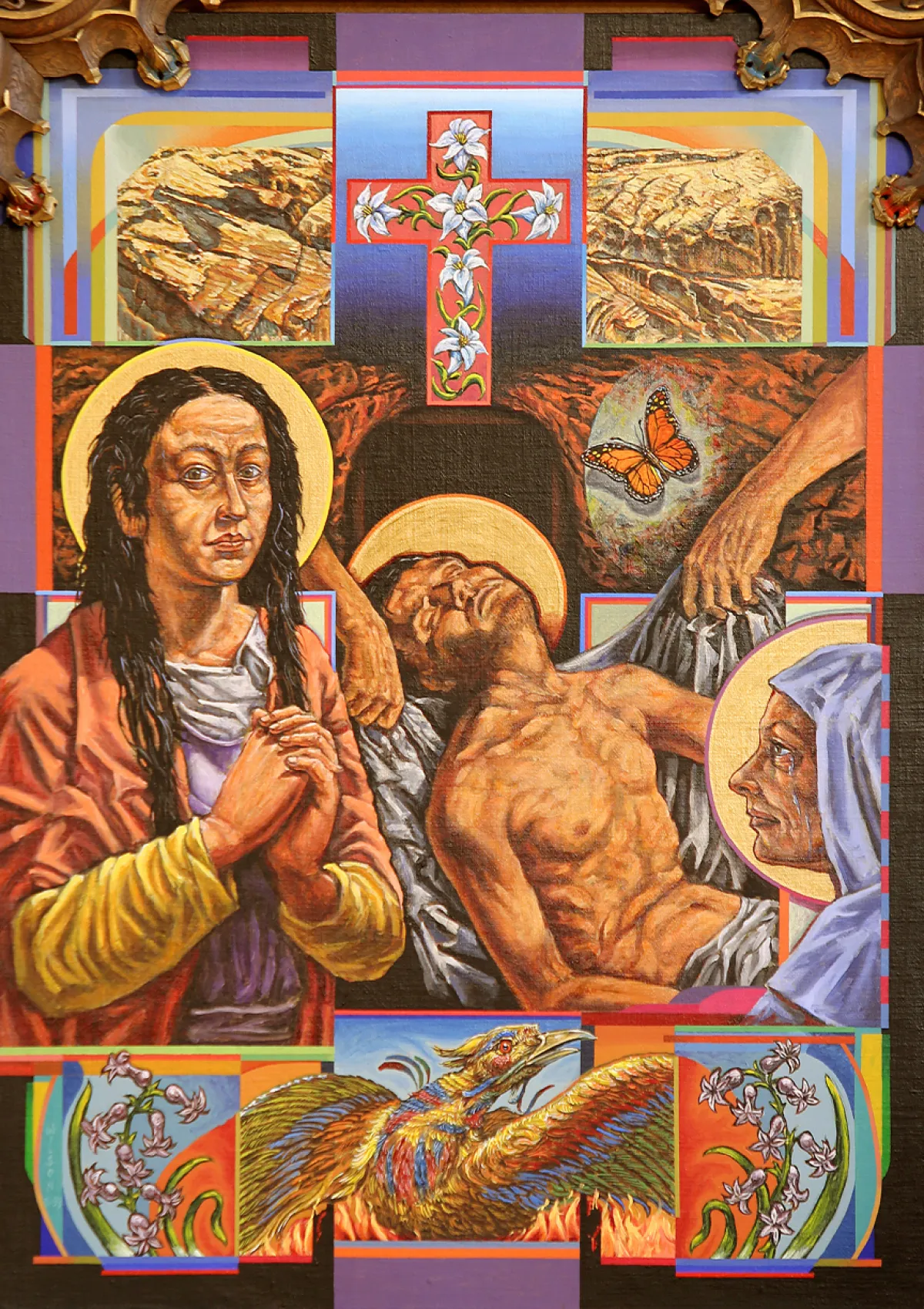
XIV. JESUS IS LAID IN THE TOMB.
The phoenix, rising dramatically from the fire, is a mythical symbol of Jesus’ resurrection and triumph over death. The suggestion of red Utah sandstone in the depiction of Jesus’ tomb implies a localization of the spiritual significance of Jesus’ death. The familiar lily cross prefigures the resurrection, as do the butterfly and the hyacinths, which are among the earliest spring flowers. To the left is Mary Magdalene, patroness of the Cathedral, who stands as if to invite the believer to interiorize the way of the cross, now at its end.